Manual
MORPH makes a sound. REC catches it in one of three rings. The rings are scanned.
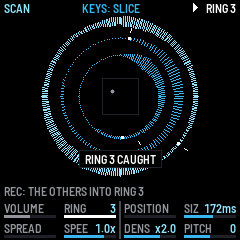
PALINDROME 1.0 is three circular recordings, 1.49 seconds each, and a synth to fill them. Every ring has a head going round it and grains read from the head, as in a granular looper; the keys chop and scrub a ring as a pocket sampler's do. A ring can also be made from the others, so sounds pass from circle to circle.
Nothing here has run on a real FM-1 yet.
Play it
- Tap a key. With no ring yet, MORPH strikes a note one ring long, ring 1 catches it from its first sample, and it starts going round.
- Scan it. KNOB1 POSITION scrubs through it; ENV freezes it, LFO reverses it; KNOB3 DENSITY thins it into grains or thickens it into a cloud.
- Hold keys. Each white key is one of sixteen places round the ring, the black keys the places between. A held key sounds the ring from there, with PLAY on or off.
- Another ring. Turn SELECT to ring 2 and tap a key: an empty ring catches the note. (Over a full ring: hold REC and tap a key, from any page.)
- From each other. Press EDIT, turn SELECT to ring 3, press REC: what you hear of rings 1 and 2 (and MORPH) is resampled into ring 3.
Buttons
| Button | Does |
|---|---|
| EDIT, HOME | SCAN page. HOME held a second empties the selected ring |
| FX | MORPH page: the keys strike its notes |
| ARP | MIX page |
| SEL | The keys on SCAN and MIX: SLICE (places round the ring) or PITCH (the ring transposed; the C as recorded). Lit: PITCH |
| PLAY | The rings going round, on and off |
| REC + a key | Held, with a key: that MORPH note is caught in the selected ring at once, from any page |
| REC (tap) | On MORPH: armed (blinking); the next note is caught in the selected ring. On SCAN or MIX: everything heard but the selected ring is resampled into it, now |
| ENV | FREEZE: the selected ring's head stops (lit); again, it goes on as it was |
| LFO | REVERSE: the selected ring runs the other way (lit while backward) |
| OCT− / OCT+ | The keys an octave down or up |
| GLO (hold) | The guide on the screen |
| SAVE, SEQ | Nothing |
SELECT chooses the ring on every page: the one the SCAN knobs set, the keys play and REC fills. RING 1 is the innermost circle. On SCAN and MIX, while the selected ring is empty, a key strikes MORPH and the ring catches the note. Recording into a ring replaces what was in it; nothing is saved at power-off. A fast turn of a knob goes four times further.
SCAN — EDIT
Each ring keeps its own settings.
| Knob | Control | Function |
|---|---|---|
| KNOB1 | POSITION | Where the grains start, round and round: turn it to scrub |
| KNOB2 | SIZE | Each grain, 20 ms to 1 s |
| KNOB3 | DENSITY | Grains overlapping: x0.25 (a grain now and then) to x5 (a cloud). About x2 is the plain recording |
| KNOB4 | PITCH | Two octaves down to two up, in semitones |
| ALGORITHM | SPEED | The head, a step a detent: -2x, -1x, -0.5x, -1/4, STILL, 1/4, 0.5x, 1.0x (as recorded), 1.5x, 2x |
| PRESETS | SPREAD | Grains scattered round the head and in time |
MORPH — FX
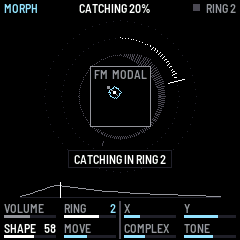
A note lasts exactly one ring. It plays MORPH as it is set now, and behind it hidden envelopes move it: X and Y travel toward their mirror image and back (a palindrome), the sound starts brighter and ends plainer and darker. MOVE says how far. Because a note is silent again by the ring's end, a caught note loops without a seam, and the same key on the same settings sounds the same way.
| Knob | Control | Function |
|---|---|---|
| KNOB1 | X | FM and ADD on the left, MODAL and FOLD on the right |
| KNOB2 | Y | ADD and FOLD at the bottom, FM and MODAL at the top |
| KNOB3 | COMPLEX | How rich each way of making sound is |
| KNOB4 | TONE | Dark to bright |
| ALGORITHM | MOVE | How far the hidden envelopes carry a note. 0: it stays where the knobs are |
| PRESETS | SHAPE | A note's loudness over its ring: a pluck, a bell, a swell |
The screen draws the path a note will take (from the knobs' place toward the mirror point) and, underneath, its loudness over one ring with the newest note's place in it.
MIX — ARP
| Knob | Control | Function |
|---|---|---|
| KNOB1..3 | RING 1..3 | Each ring's level |
| KNOB4 | MORPH | MORPH's own level as you play it |
| ALGORITHM | DAMP | The rings darker |
| PRESETS | WIDTH | The rings spread across the stereo field |
Limits
Three rings of 1.49 s at 22 kHz, up to six grains each, four MORPH notes. Rings live in RAM only. A capture's level is evened (its loudest sample to about 70%); a capture with nothing in it leaves the ring empty.