BabbleBeat
A word on every key, and a tiny robotic voice. A third FM-1 firmware beside STRATA and PALINDROME. Sentences are built by grammar rules; the voice is a formant robot that says only the words it knows.
Custom firmware, installed at your own risk. It has not run on a real FM-1 yet. Install · Try it in the browser.
Quick start
- Press a white key. It has a word, and says a phrase about it. Press it again: the same phrase, now and then a new one.
- Press the black key to its right: the same word in another kind of phrase (a question, a "not", a "was").
- Keep playing keys. A word stays on its key; now and then it moves to the next word of its world.
- SEQ puts a new word on the key. REC remembers the key's word; RECALL brings it back into other phrases.
- PLAY babbles about the key's word; HOME stops.
- EDIT, then GRAMMAR (KNOB1): every phrase is built another way, bare to nested.
- SEL steps through the three sets of knobs: VOICE, MOUTH, WORDS. Lost? Hold GLO.
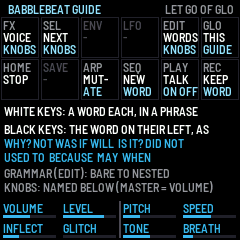
Buttons
| Button | Action |
|---|---|
| PLAY | Babble: one phrase after another about the key's word |
| SEQ | A new word on the key, and a phrase about it |
| ARP | The key's phrase made again |
| REC | Remember the key's word |
| SEL | The next set of knobs: VOICE → MOUTH → WORDS |
| FX | VOICE knobs |
| EDIT | WORDS knobs |
| HOME | Stop speaking and turn off the babble |
| OCT- / OCT+ | The whole voice down or up an octave |
| GLO (hold) | The guide: what every button does, on the screen |
| SAVE, ENV, LFO | Not used; the screen says so |
Keys
A white key is a word. The sixteen take the nouns of the WORLD in order, so neighbouring keys are neighbouring words. A key says a plain statement about its word and keeps it, so you can come back to it. Lower keys speak in a lower voice. The screen shows WORD: and a row of sixteen marks, the tall one the key in use.
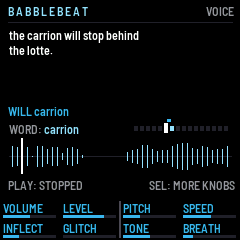
A black key is a kind of phrase. It uses the word of the white key on its left:
| Black key, left to right | Kind | Example with mirror (GRAMMAR at PLAIN) |
|---|---|---|
| 1 | WHY? | why does the mirror haunt the static? |
| 2 | NOT | the mirror does not follow the machine. |
| 3 | WAS | the mirror was silver inside the signal. |
| 4 | IF | if the mirror dreams, the filter watches the voltage. |
| 5 | WILL | the mirror will forget the circuit. |
| 6 | IS IT? | does the mirror haunt the engine? |
| 7 | DID NOT | the mirror did not corrupt the voltage. |
| 8 | USED TO | the mirror used to corrupt the static. |
| 9 | BECAUSE | the mirror watches the signal because the terminal sings. |
| 10 | MAY | the mirror may follow the voltage. |
| 11 | WHEN | when the mirror vanishes, the antenna will forget the engine. |
WORLD and the words
BabbleBeat knows about 9,800 words: 6,807 nouns, 1,412 adjectives, 1,183 verbs, 350 adverbs and 30 prepositions. The nouns are in twenty-one worlds. WORLD (EDIT, SELECT) chooses the world the keys draw from; the screen names it as you turn. It starts on ALL, which is every world one after another, so the whole vocabulary is in play from the first key.
| WORLD | Nouns | Such as |
|---|---|---|
| ALL (where it starts) | 6,807 | every world below, in turn |
| MACHINE, DREAM, BODY, GOTHIC | 12 each | the original hand-made worlds: circuit, ghost, tongue, crypt |
| ANIMAL, PLANT, FOOD | 450, 450, 436 | peacock, asp · bluebell, soybean · scone, tripe |
| THING, PLACE, MATTER | 450 each | headlight, vase · hideout, shoreline · nylon, downpour |
| TIME, MIND, TALK | 172, 450, 450 | preseason · tendency, piety · jargon, libretto |
| DEED, PERSON, GROUP | 450, 450, 344 | haircut, coup · novelist, commander · synod, court |
| FLESH, SHAPE, TRAIT | 260, 147, 450 | sartorius · whorl · leniency, timbre |
| STATE, MONEY | 450 each | honour, suffering · bankroll, surtax |
- Neighbouring keys are kin. A world's words are in a family order, so the sixteen keys hold related words, and a word that moves (WANDER) steps to a relative.
- Each power-on starts somewhere else in the world, so the keys are not always the same sixteen.
- Turn WORLD into another world and every key takes a new word from it: the key on the screen at once, the others when played.
- Verbs lean toward their subject. A sentence about an animal prefers verbs of moving, eating and sensing; one about money, verbs of having and giving. WANDER loosens this: at the top, any verb goes with anything.
- Adjectives, adverbs and prepositions are shared by all worlds and are unrestrained.
The words outside the first four worlds were chosen by a script, not one by one, and it was told to be generous. It says strange things. That is the idea.
GRAMMAR
GRAMMAR (EDIT, KNOB1) sets how every phrase on the unit is built: white keys, black keys and PLAY's babble. There are five levels. Turn across one and the phrase on the screen is built again that way and said; each other key follows when it is next played. The screen names the kind and the level under the phrase, for example WHY? NESTED.
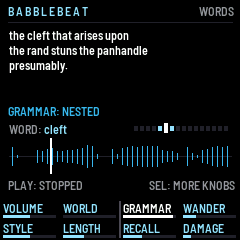
| GRAMMAR | Level | A white key | The WHY? key | The NOT key |
|---|---|---|---|---|
| 0–19 | BARE | the strange mirror. | why the mirror? | not the mirror. |
| 20–39 | SIMPLE | the mirror vanishes. | why is the mirror silver? | the mirror is not synthetic. |
| 40–59 | PLAIN | the mirror watches the static. | why does the mirror haunt the static? | the mirror does not follow the machine. |
| 60–79 | JOINED | the mirror waits, but the filter forgets the engine. | why does the mirror watch the signal, and why does the circuit sleep? | the mirror does not swallow the engine, and the engine does not whisper. |
| 80–100 | NESTED | the mirror that opens the robot returns. | why does the mirror that waits watch the speaker when the terminal sleeps? | the mirror that waits does not haunt the robot because the robot is not pale. |
What changes, and how fast
| Knob (WORDS) | Sets |
|---|---|
| WANDER | How often a key's word moves when you play it. It moves one step, to the next word of its world, never a jump. At 0 it never moves |
| DAMAGE | How often a key's phrase is made again when you play it. At 0 a phrase stays until you change it. Past 60 it may be broken instead (a word doubled, dropped, an "again") |
When a white key's word moves, the black key beside it follows the next time it is played.
WORDS — EDIT
| Knob | Control | Function |
|---|---|---|
| KNOB1 | GRAMMAR | How every phrase on the unit is built: BARE, SIMPLE, PLAIN, JOINED, NESTED |
| KNOB2 | WANDER | How often a key's word moves a step; also, nouns borrowed from outside the world and verbs that do not suit their subject |
| KNOB3 | RECALL | How often the remembered word returns. Past 70 the phrases fix on it and loop back on themselves: "the mirror was, the mirror was pale." |
| KNOB4 | DAMAGE | How often a key's phrase is made again as it is played; past 60 it may be broken instead |
| SELECT | WORLD | ALL, or one of the twenty-one worlds, for the keys' words. Turned into another, every key takes a new word from it |
| ALGORITHM | LENGTH | High values can append a further clause (from PLAIN up) |
| PRESETS | STYLE | Statements at low values; mixed in middle; questions at high values |
VOICE — FX
Each word is said with its stress where a dictionary puts it: the stressed syllable longer, fuller and lifted in pitch, the others lighter, and the "uh" of "about" reduced. Little words (the, of, is) are said lightly.
| Knob | Control | Function |
|---|---|---|
| KNOB1 | PITCH | Base pitch for automatic speech |
| KNOB2 | SPEED | How fast it talks: about three times slower to three times faster than the middle |
| KNOB3 | TONE | A darker, larger voice to a brighter, smaller one |
| KNOB4 | BREATH | Breath noise in the voiced sounds |
| SELECT | LEVEL | Synthesizer voice volume |
| ALGORITHM | GLITCH | Stutters: the start of a word caught as it is said and played again, two to five times, before the word goes on ("th-th-the mirror"). Higher: more often, shorter, and sometimes in the middle of a word |
| PRESETS | INFLECT | How much the pitch moves: a lift on each stressed syllable, a fall at the end, a rise for a question |
MOUTH — SEL
SEL steps VOICE → MOUTH → WORDS. The middle of each MOUTH knob is the voice as it is made.
| Knob | Control | Function |
|---|---|---|
| KNOB1 | SIZE | A small mouth (every resonance higher) to a large one |
| KNOB2 | SLUR | Crisp, to sliding lazily from sound to sound |
| KNOB3 | GAP | The quiet between words: run together, to spaced out |
| KNOB4 | WAVER | How much the pitch trembles |
MASTER always controls volume.
How the sentence engine works
A compact lexicon tags parts of speech. There are twelve kinds of phrase (the statement and the eleven black-key kinds), and each has a form at each of GRAMMAR's five levels. Statements use third-person verbs, and base verbs follow "does", "did", "will" and "may". Verbs that take no object are never given one.
REC keeps a word in a small memory slot; RECALL governs whether a later phrase uses it. WORLD decides the nouns; WANDER can cross worlds. LENGTH can add a further clause. DAMAGE past 60 lets tokens repeat, disappear or be interrupted by "again".
The first four worlds loosely echo an earlier Python WordNet/Dracula experiment and are written by hand. The rest of the words are generated from two public word lists: see the sources and their notices.
Voice limitations
The voice is a small formant synthesizer, its words spelled from the CMU Pronouncing Dictionary with their stress: a glottal pulse and breath noise through four gliding formants, with shaped noise for hisses and stops. It is robotic on purpose, and it is not a general English TTS engine or CHIMERA's modeled vocal tract. There is no text input, no recording, no save/load of patches and no MIDI support in the app yet. The firmware has not run on a real FM-1: the first trials must establish intelligibility.